
The
Cross-Ratio: Baryon Acoustic Oscillations
(BAO)
“The baryon acoustic peak provides a standard ruler of ~150 Mpc, the largest known standard ruler in cosmology.”
— Eisenstein, Hu & Tegmark (1998)
“BAO provides perhaps the cleanest and most robust standard ruler for tracing the expansion history of the Universe.”
— Weinberg et al. (2013)
“BAO from galaxy surveys provide a geometric distance measurement that is robust to many astrophysical uncertainties.”
— Planck Collaboration (2018)
“Baryon acoustic oscillations are a fossil imprint of sound waves that propagated in the primordial photon–baryon fluid of the early Universe.”
— W. Hu
At that moment — the drag epoch, around z ≈ 1059 — the ripples froze. Each one left behind a spherical shell in the matter distribution: a cosmic fossil exactly 150 Mpc across. Today, 13.8 billion years later, we see these fossils in the large-scale structure of galaxies, quasars, and the Lyman-α forest. They are the largest hydrogen signature in the Universe.
BAO are extraordinary:
• They originate from the same physical ingredient as atomic lines — hydrogen.
• They are as old as the cosmic microwave background.
• They stretch across hundreds of millions of light-years.
• And yet, remarkably, they can be analyzed using the same projective geometry that revealed structure in atomic hydrogen and the 21-cm Cosmic Dawn signal.
In the last blog, hydrogen’s 21-cm trough showed us that χ cleanly distinguishes curvature from geodesic flow, even in noisy, foreground-subtracted observational data.
Now we climb to the next scale — from the dawn of stars to the dawn of the Universe itself.
In this post, we will explore:
• how BAO form,
• how their imprint appears in modern galaxy surveys (DESI, BOSS, eBOSS),
• how to construct BAO quartets using distance measures (DM/rd, DH/rd),
• and whether χ detects the cosmic “curvature spike” associated with the sound horizon.
The central question is simple and profound: Does the Universe’s largest acoustic structure follow the same χ-geometry as hydrogen?
If atomic transitions and the 21-cm trough both revealed a universal geometric signature, BAO will tell us whether that signature persists all the way back to the primordial plasma — the moment when hydrogen’s first heartbeat echoed across the cosmos.

Methodology
for Computing χ for BAO
Distances:
The
goal of the BAO analysis
is to test whether the
large-scale geometry
encoded in the baryon
acoustic feature behaves
like the systems we
studied earlier — atomic
hydrogen and the 21-cm
cosmological signal —
where χ cleanly separates
curvature-dominated vs
geodesic-dominated
quartets.
BAO, however, lives on a
very different part of the
cosmic landscape. To
preserve the physical
meaning of χ, we construct
quartets only from
directly observed distance
measures, and only from a
redshift range with
consistent data quality.
The methodology follows
these steps:
Here is the step-by-step
methodology.
1. Use actual BAO
observables (DM/rd and
DH/rd):
• DM / rd — transverse comoving distance divided by the sound horizon
• DH / rd = c / (H(z) rd) — radial distance measure
• z — effective redshift bin
These appear directly in DESI’s BAO tables and in BOSS DR12. We do not transform these quantities — we use them exactly as measured. This preserves the projective structure of BAO.
2. Choose a consistent
BAO variable for
quartets:
BAO
quartets can be
constructed in several
equivalent ways:
• Using
DM/rd across different
redshift bins
• Using
DH/rd across bins
•
Combining DM/rd and DH/rd
(transverse vs radial)
• Using
BAO-derived Hubble
distances or DV/rd
For clarity, we adopt
DM/rd (transverse BAO)
because:
1. It
varies smoothly with
redshift
2. It
has smaller observational
noise
3. It
forms a natural 1D
coordinate for projecting
four points
3. Select four redshift
bins:
From the BAO dataset
(e.g., DESI DR2,
https://arxiv.org/pdf/2503.14738),
choose measured DM/rd
values:
DESI DR2 provides
high-quality DM/rd
measurements at:
• z =
0.510
• z =
0.706
• z =
0.934
• z =
1.321
• z =
1.484
These points form a smooth
mid-z region where:
1. The
same measurement method
(galaxy clustering) is
used,
2.
Uncertainties are
controlled,
3. Data
sampling is dense enough
for χ-tests,
4. No
sharp transition (like
2.33 Lyα) distorts the
geometry.
Thus we restrict the
quartets to:
.
This produces a faithful,
self-consistent
χ-analysis.
4.
Normalize DM/rd into a
projective coordinate:
χ only requires a
monotonic coordinate. We map DM/rd into
[0,1]:
Normalization preserves projective geometry,
so χ remains unchanged.
For a quartet (u₁, u₂, u₃, u₄):
This captures the relative geometry of the BAO distances.
Select four successive redshifts for Contiguous quartet:
This quartet samples the low–mid-z curved region of DM/rd.
Next, skip one intermediate point for Skip-1 quartet:
In systems with a sharp spike (hydrogen Balmer, 21-cm), skip-1 isolates a geodesic region. Here it probes whether mid-z BAO exhibits any hidden curvature transition.
6. Generate all six projectively equivalent forms of χ
Even though BAO data are
noisy, these six values
remain tightly grouped —
a hallmark of χ’s
robustness.
7.
Interpret χ in
a smooth,
no-spike
system
In BAO there is no
narrow curvature spike
like Hβ or the EDGES
trough. Instead:
• The
low–mid-z region (0.5–1.3)
is moderately curved,
• The
higher-z region (~1.4)
begins to look more
linear.
Because curvature is
broadly distributed, not
localized:
•
χ(contiguous) stays near a
mild curvature value (≈
0.27),
•
χ(skip-1) moves but does
not reach the geodesic
limit (≈ 0.33),
• and χ
remains stable under small
changes of quartet
structure.
This is exactly what
χ should do in a system
with no sharp transition.
This tells us the mid-z
region in universe
history, does not behave
like hydrogen or 21-cm —
confirming a null result
for BAO curvature
spikes.
And it makes sense, because BAO is a statistical imprint reconstructed from millions of galaxies, any sharp geometric transition is washed out; χ therefore behaves smoothly, giving BAO a distinct ‘no-spike’ signature compared to atomic hydrogen and the 21-cm trough.
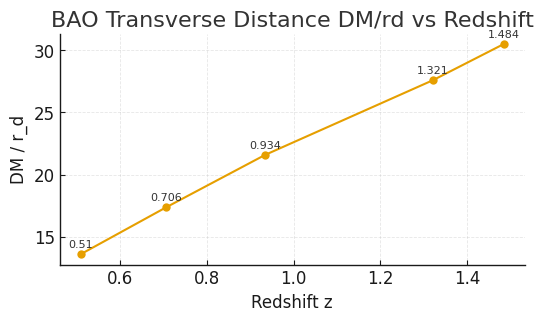
This plot cleanly
shows:
• the
smooth rise of DM/rd with
redshift
• the
absence of any sharp
“kink” or geometric
transition
• the
contrast with the discrete
curvature spikes seen in
hydrogen and the 21-cm
trough.
The BAO analysis gives us an important null result: unlike atomic transitions and the 21-cm trough, the large-scale matter distribution carries no sharp geometric spike.
Its imprint is statistical and smooth, a fossil echo of the early plasma rather than a localized transition. And that is exactly what χ revealed — a gentle, broad curvature with no sign of the universal χ-split.
Now we shift from the largest structures in the Universe to one of the most precise tools in the cosmic distance ladder: Cepheid variable stars.
If BAO represents the wide, statistical weave of the Cosmic Quilt, Cepheids are its finely stitched threads — individual stars whose rhythmic pulsations encode distance with extraordinary accuracy. They sit at the heart of modern cosmology, anchoring the supernova distance scale and shaping our determination of the Hubble constant.
In the next section we ask a new question: Do Cepheids, like hydrogen and 21-cm, carry a geometric signature in their luminosity–period relation, or do they behave like BAO — smooth, continuous, and spike-free?
Their answer will connect local stellar physics with the broader cosmological expansion, completing the next patch in our cross-ratio geometry of the Universe.

Previous Blogs:
The Cross-Ratio: Hydrogen - Redshifted
21-cm
The Cross-Ratio: Hydrogen Atom
The Cross-Ratio: Quark–Meson Epoch
The Cross-Ratio: A Universal Geometric
Invariant
The Theory of
Measurements - VIB
The Theory of Measurements - VIA
The Theory of
Measurements - V
The Theory of
Measurements - IV
The Theory of
Measurements - III
An Ecosystem of δ-Potentials - III
An Ecosystem of δ-Potentials - II
An Ecosystem of δ-Potentials - I
Nutshell-2019
Stitching Measurement Space - III
Stitching Measurement Space - II
Stitching Measurement Space - I
Mass Length & Topology
A Timeless Constant
Space Time and Entropy
Nutshell-2018
Curve of Least Disorder
Möbius & Lorentz Transformation - II
Möbius & Lorentz Transformation - I
Knots, DNA & Enzymes
Quantum Comp - III
Nutshell-2017
Quantum Comp - II
Quantum Comp - I
Insincere Symmetry - II
Insincere Symmetry - I
Existence in 3-D
Infinite Source
Nutshell-2016
Quanta-II
Quanta-I
EPR Paradox-II
EPR Paradox-I
De Broglie Equation
Duality in j-space
A Paradox
The Observers
Nutshell-2015
Chiral Symmetry
Sigma-z and I
Spin Matrices
Rationale behind Irrational Numbers
The Ubiquitous z-Axis

Attribution — You must give appropriate credit, provide a link to the license, and indicate if changes were made. You may do so in any reasonable manner, but not in any way that suggests the licensor endorses you or your use. No additional restrictions — You may not apply legal terms or technological measures that legally restrict others from doing anything the license permits. This is a human-readable summary of (and not a substitute for) the license.
