The
Cross-Ratio: A Universal Geometric Invariant
13th October 2026
“Everything that remains unchanged under projection constitutes a true projective property.”
—Poncelet, Traité des propriétés projectives des figures, 1822.
“Harmonic division is unaltered by projection.”
- Jakob Steiner,
from Systematische Entwickelung der Abhängigkeit geometrischer Gestalten voneinander, 1832; and Über die geometrischen Constructionsprinzipien, 1848
“The anharmonic ratio belongs to projective geometry alone; it can be defined without recourse to metric notions.”
— G. K. von Staudt, Beiträge zur Geometrie der Lage (1847–1856).
“The unit point U serves to normalize the system so that anharmonic values become comparable under different projections.”
- W. G. K. Hime, Theory of the Anharmonic Ratio and Allied Topics (1893).
“By choosing three points as reference, all other points may be expressed by ratios of these, independent of any metric.”
— August Ferdinand MöbiusDer barycentrische Calcul,1827
 In the
Theory of Measurements, the
observer’s capability is
parameterized by an
effective
fine-structure-like constant
.
In our S-frame
formulation,
= 1 represents a
hypothetical
maximum-efficiency observer
— one whose measurements lie
infinitesimally close to the
light cone (null limit).
In the
Theory of Measurements, the
observer’s capability is
parameterized by an
effective
fine-structure-like constant
.
In our S-frame
formulation,
= 1 represents a
hypothetical
maximum-efficiency observer
— one whose measurements lie
infinitesimally close to the
light cone (null limit).Different observers, from subatomic to cosmic, correspond to different values of α. An electron ( ≈1/137), a proton ( ≫1), an astrophysical observer ( ≈ 0), and even the universe as a whole can be treated as observers with different capabilities.
The structures we see — atomic spectra, molecular lines, Cepheid luminosity, BAO scales, and even the expansion rate — are the outcomes of measurements performed by these varying-capability observers.
Therefore, it is natural to ask whether a fundamental, observer-independent quantity exists — a quantity capable of unifying the structures we see across atomic, astrophysical, and cosmological scales.
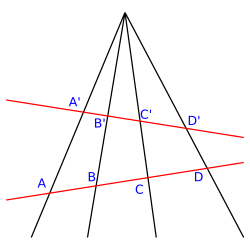 One such
quantity is the cross-ratio
— a projective invariant that
remains unchanged under the
transformations connecting
observers of different
capabilities. In the
diagram shown here the cross
ratio is defined as:
One such
quantity is the cross-ratio
— a projective invariant that
remains unchanged under the
transformations connecting
observers of different
capabilities. In the
diagram shown here the cross
ratio is defined as:The value remains unchanged for any line intersected by four rays.
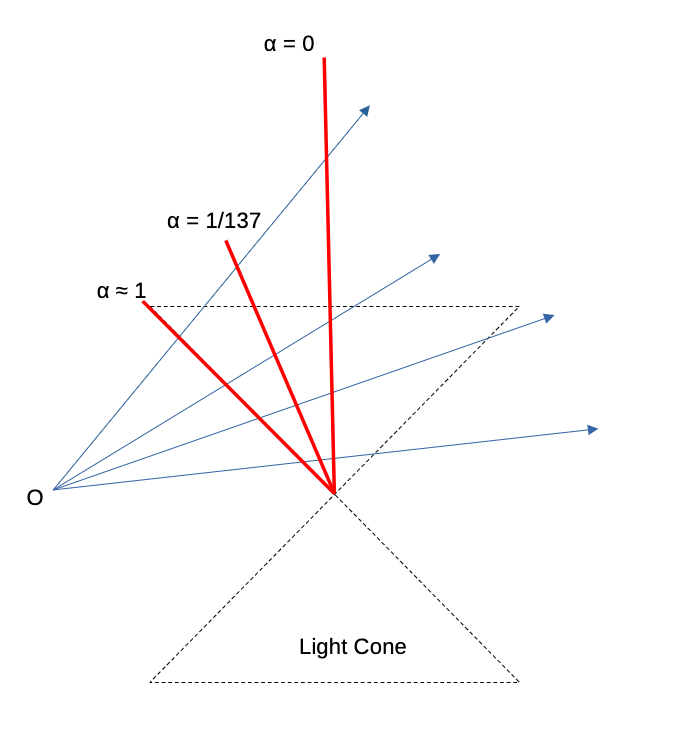 Our motivation
for introducing the
cross-ratio as an
observer-independent quantity
is illustrated here. In
the attached diagram, each
line labeled by an α-value
represents an observer with a
different measurement
capability, all measuring an
information source located at
O.
Our motivation
for introducing the
cross-ratio as an
observer-independent quantity
is illustrated here. In
the attached diagram, each
line labeled by an α-value
represents an observer with a
different measurement
capability, all measuring an
information source located at
O.Our assumption is that if the cross-ratio truly remains unchanged across observers of varying capabilities, then we should be able to determine a universal value of the cross-ratio, by analyzing experimental data across many physical domains.
This idea highlights the central principle of discrete measurement space: physical laws arise from the underlying geometry, while the measurements we record depend on the observer.
In this section, we provide a historical context to the development of ideas behind the cross-ratio, and related concepts.
In 1822, Jean-Victor Poncelet proposed a radical vision: Rebuild geometry using only projection — inscriptions, intersections, tangencies — with no distances or angles. This became known as the Poncelet program, the founding manifesto of projective geometry.
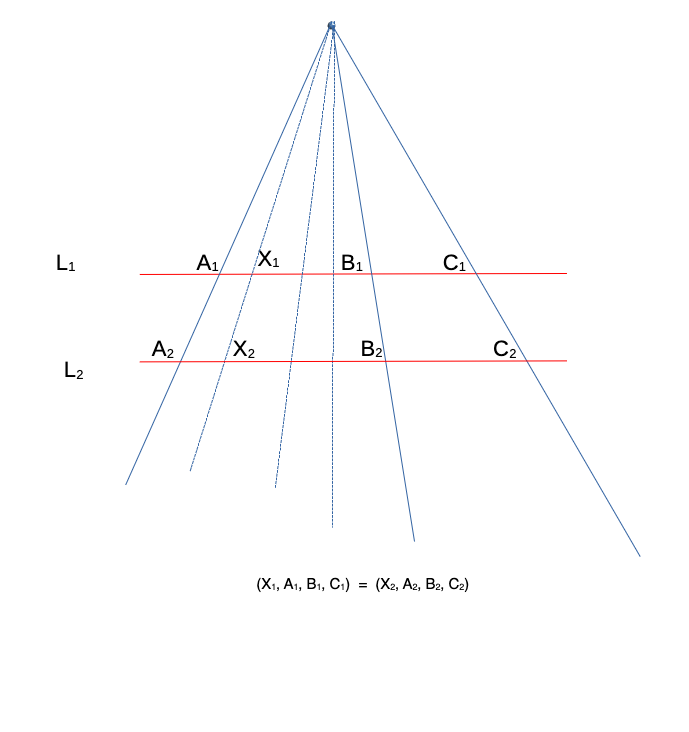 In 1832, Jakob
Steiner
advanced
Poncelet’s vision
and built a
complete geometry
on projective
foundations. A
conic need not be
defined by
equations or
distances.
Instead: Any conic
can be generated
from a family of
tangents
constructed using
two reference
lines L₁ and
L₂. Steiner
showed that the
entire structure
of the point X
varying on L1
can be described
through harmonic
division and the
cross-ratio:
In 1832, Jakob
Steiner
advanced
Poncelet’s vision
and built a
complete geometry
on projective
foundations. A
conic need not be
defined by
equations or
distances.
Instead: Any conic
can be generated
from a family of
tangents
constructed using
two reference
lines L₁ and
L₂. Steiner
showed that the
entire structure
of the point X
varying on L1
can be described
through harmonic
division and the
cross-ratio:Around same time, August Ferdinand Möbius introduced barycentric coordinates, representing points as weighted averages of others. This provided:
- an algebraic method for describing geometric relations,
- an early coordinate system suited for projective spaces,
- and
the algebraic
underpinning
for later
analytic
treatments.
William Rowan Hamilton further expanded the analytic side of projective geometry. Hamilton’s key ideas: O and U, were defined as:
• O — the origin (projective zero)
• U — the unit point (projective one)
This allowed the projective line to be treated analytically:
Herbert Hime extended Hamilton’s system and built the cleanest 19th-century description of the projective line. Hime’s contributions:
- Adopted Hamilton’s O and U as structural reference points
- Used four-point tuples (A,B,C,D) to define projective configurations
- Formalized the anharmonic cross-ratio as their invariant
- Developed unit points, harmonic conjugates, and involutions
- Demonstrated
that every
projective
mapping is
determined by
its action on
four points
After Hime’s analytic formulation, the next major advance came from Karl von Staudt, who removed all reliance on coordinates and showed that projective geometry could be constructed purely synthetically. He introduced the concept of projective addition and multiplication, giving the cross-ratio a completely geometric definition independent of measurement.
Later in the 19th century, Felix Klein unified these ideas through the Erlangen Program, which reinterpreted every geometry as the study of invariants under a corresponding transformation group. Projective geometry, in Klein’s hierarchy, is governed by the projective group, and its central invariant is precisely the cross-ratio. Together, von Staudt’s synthetic foundations and Klein’s group-theoretic vision placed projective geometry on a modern footing and established the cross-ratio as the fundamental invariant of projective space.
David Hilbert in his Foundations of Geometry (1899), incorporated projective axioms alongside metric ones, showing that the cross-ratio provides the bridge between synthetic projective geometry and analytic metrical structures.
Hermann Weyl extended this viewpoint by generalizing geometry to include scale transformations, leading to gauge theory, where invariants arise from symmetries rather than fixed distances—an echo of projective principles.
At the same time, Élie Cartan developed the method of moving frames and the theory of connections, revealing that geometric structures are best understood through their transformation groups and associated invariants.
Together, Hilbert, Weyl, and Cartan transformed projective ideas into a modern geometric language—one where symmetry, invariance, and observer-dependent structure became the foundational tools for describing physical space.
The foundation of the work related to the application of cross-ratio to the physical systems in j-space, comes from Steiner’s projective construction of lines and conics, and Hime’s four-point formalism based on Hamilton's work. Their work shows that geometry can be defined without distances and that invariants arise solely from relations among four points — precisely the idea we extend to observer-dependent measurement in physical systems.
By
treating each
physical observer
as a projective
“line” (shown in
red) with a
characteristic
capability
,
we ask whether the
cross-ratio ,
remains invariant
across
measurements made
from widely
different
observational
frames—from atomic
scales to
cosmological
distances, each
corresponding to a
different
.
Consequently, in
this accompanying
diagram, the value
of
should not change
with the variation
of
from 0 to 1.
The invariance of , is a powerful criterion for finding geodesics in complex systems, because χ remains unchanged under all projective distortions, allowing us to detect the underlying “straightest possible path” even when the system itself is curved, dynamic, or measurement-dependent.
In projective geometry, a geodesic is precisely the curve along which χ remains constant for all admissible quadruples.
Thus, when χ is stable across datasets or physical configurations, it signals that we are tracking a genuine projective geodesic of the underlying measurement space — even when that space is non-linear, observer-dependent, or the underlying geometry is Finsler-based, , instead of Riemannian, .
In this sense, projective geometry becomes not just a mathematical concept, but a measurement-geometry framework for understanding the fundamental structures of the physical universe.
In extending classical projective geometry to our measurement framework, we move beyond the use of straight lines and instead treat conic sections as the fundamental projective objects. This follows Steiner’s insight that a conic can be constructed purely from projection and tangency, without coordinates or distances.
In our work, the conic serves as a richer geometric stage: it encodes not just linear relations, but the curved structure required to represent observer-dependent measurement, light-cone deformation, and vacuum geometry.
In this section, we describe the methodology used to calculate the cross-ratios from different data sets. Our selection principle for tuples states that “Across all physical scales, if we choose 4-tuples based on increasing observer efficiency, minimal decoherence, and clean projective structure, their normalized χ tends to cluster near the primordial invariant.”
1. Choose reference curves L1 and L2:
Using Steiner’s tangent-fan construction, we select two reference directions or curves that define the projective environment. (These can be straight lines or any conic, depending on the physical geometry.)1
2. Place the physical quantities on the projective line:
Each physical measurement (frequency, radius, redshift, energy level, BAO distance, etc.) is mapped to a point on the projective line determined by L1 and L2.
This step uses Hime’s anharmonic-coordinate philosophy: every data set must be represented as a projective point relative to a common baseline.
3. Form the projective 4-tuple (A, B, C, D):
Four physically meaningful points are selected following “observer-efficiency ordering” (weakest → strongest).
The pair (O, U)—reference point and unit point—fix the baseline and scale, ensuring consistency across datasets.
4. Canonicalize the triple (A, B, D) to (0, 1, )
A projective transformation (Möbius map) sends
• A maps to 0
• B maps to 1
• D maps to
This is the standard projective form used by Steiner, Hime, and modern projective geometry. It removes all unit-dependence, scale choices, and experimental calibration differences.
5. Compute the invariant cross-ratio
This value is unchanged by any stretching, bending, rescaling, or choice of reference conic—exactly as predicted by Steiner’s geometry and Hime’s anharmonic coordinates.
In this blog, we explored how the universe can be understood the same way we understand shapes and shadows. Long ago, visionary thinkers like Poncelet, Steiner, Möbius, Hamilton, and Hime discovered that some patterns never change, even when you stretch them, tilt them, or look at them from different places. One of these magic patterns is called the cross-ratio — a special number made from four points.
This means the universe has a hidden pattern sewn into it, a pattern that stays steady from the smallest atoms to the biggest galaxies. By following this pattern, we can trace the universe’s “straightest paths,” discover how it measures itself, and learn how all the patches of the universe fit together.
We will discussing real cosmic threads — light from atoms, stars, and galaxies — and see how this secret stitch shows up everywhere in the universe.
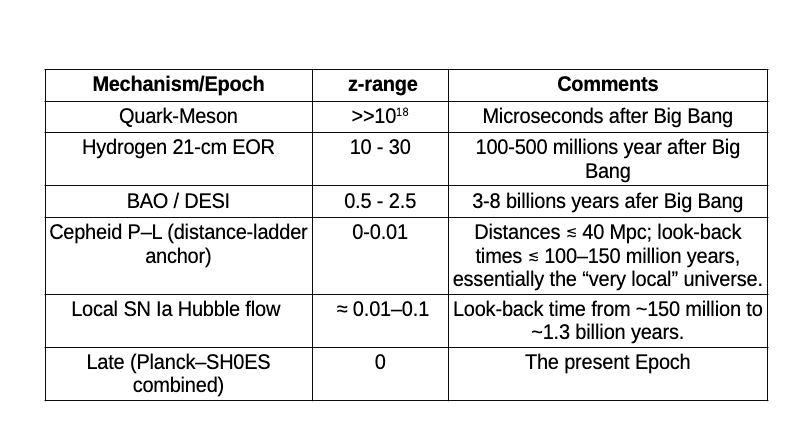
Our approach will be to calculate cross-ratio values as the universe evolves i.e. from very high z values to 0, as shown here:
______________
1. For a really nice
visualization of Steiner's method,
please review, "Construction of all
conics as envelopes of straight lines",
https://www.youtube.com/watch?v=Yn6dWxw787w.

Previous Blogs:
The Theory of
Measurements - VIB
The Theory of Measurements - VIA
The Theory of
Measurements - V
The Theory of
Measurements - IV
The Theory of
Measurements - III
An Ecosystem of δ-Potentials -
IVA
An Ecosystem of δ-Potentials - III
An Ecosystem of δ-Potentials - II
An Ecosystem of δ-Potentials - I
Nutshell-2019
Stitching Measurement Space - III
Stitching Measurement Space - II
Stitching Measurement Space - I
Mass Length & Topology
A Timeless Constant
Space Time and Entropy
Nutshell-2018
Curve of Least Disorder
Möbius & Lorentz Transformation - II
Möbius & Lorentz Transformation - I
Knots, DNA & Enzymes
Quantum Comp - III
Nutshell-2017
Quantum Comp - II
Quantum Comp - I
Insincere Symmetry - II
Insincere Symmetry - I
Existence in 3-D
Infinite Source
Nutshell-2016
Quanta-II
Quanta-I
EPR Paradox-II
EPR Paradox-I
De Broglie Equation
Duality in j-space
A Paradox
The Observers
Nutshell-2015
Chiral Symmetry
Sigma-z and I
Spin Matrices
Rationale behind Irrational Numbers
The Ubiquitous z-Axis
An Ecosystem of δ-Potentials - III
An Ecosystem of δ-Potentials - II
An Ecosystem of δ-Potentials - I
Nutshell-2019
Stitching Measurement Space - III
Stitching Measurement Space - II
Stitching Measurement Space - I
Mass Length & Topology
A Timeless Constant
Space Time and Entropy
Nutshell-2018
Curve of Least Disorder
Möbius & Lorentz Transformation - II
Möbius & Lorentz Transformation - I
Knots, DNA & Enzymes
Quantum Comp - III
Nutshell-2017
Quantum Comp - II
Quantum Comp - I
Insincere Symmetry - II
Insincere Symmetry - I
Existence in 3-D
Infinite Source
Nutshell-2016
Quanta-II
Quanta-I
EPR Paradox-II
EPR Paradox-I
De Broglie Equation
Duality in j-space
A Paradox
The Observers
Nutshell-2015
Chiral Symmetry
Sigma-z and I
Spin Matrices
Rationale behind Irrational Numbers
The Ubiquitous z-Axis

Attribution — You must give appropriate credit, provide a link to the license, and indicate if changes were made. You may do so in any reasonable manner, but not in any way that suggests the licensor endorses you or your use. No additional restrictions — You may not apply legal terms or technological measures that legally restrict others from doing anything the license permits. This is a human-readable summary of (and not a substitute for) the license.
