
The
Cross-Ratio: Hydrogen - Redshifted 21-cm
“Neutral hydrogen should exhibit a spectral line at 21 centimeters arising from the hyperfine splitting of its ground state.”
— H. C. van de Hulst, 1944 theoretical memorandum (later summarized in Nederl. Tijdschr. Natuurkunde)
“A radio-frequency emission line at 1420 Mc/s, attributable to galactic neutral hydrogen, has been detected.”
— Ewen & Purcell, Nature, 1951
“The 21-cm radiation opens an entirely new view of the structure of our Galaxy.”
— J. H. Oort, 1952 Leiden Observatory report
“Hydrogen-line observations reveal the spiral nature of the Galaxy with remarkable clarity.”
— Christiansen & Kerr, Australian Journal of Physics, 1953
“The 21-cm transition is uniquely sensitive to the distribution and motion of hydrogen during the earliest epochs.”
— R. H. Dicke, Princeton cosmology lectures
“The 21-cm signal is the most direct probe of the universe’s Dark Ages and the birth of the first stars.”
— NASA/ESO public science summaries
Why this matters?
This feature marks the period when the first stars turned on, the intergalactic medium cooled and decoupled from the cosmic microwave background, and hydrogen’s hyperfine structure began to directly “whisper” its story. Selecting epochs around this feature gives us candidates for our projective quartet.
Methodology for Computing
χ for Redshifted
Hydrogen 21-cm Lines:
To compare the geometric
behavior of atomic
hydrogen transitions with
the global 21-cm signal
from the early Universe,
we compute the same
projective
invariant—χ—using real,
observed 21-cm
brightness-temperature
data.
The 21-cm curve is
redshifted, noisy,
foreground-subtracted, and
instrument-calibrated, yet
χ behaves just as it does
in the laboratory Balmer
series.
1. Use real EDGES
observational data:
All χ-values are computed using the actual sky-averaged 21-cm brightness temperature, not stylized fits or simulated curves. (https://loco.lab.asu.edu/edges/edges-data-release/)
These files
contain:
•
Frequency (50–100 MHz)
•
Corresponding redshift z
•
Extracted global 21-cm
signal (T21)
•
Repeated nightly spectra
for consistency checks
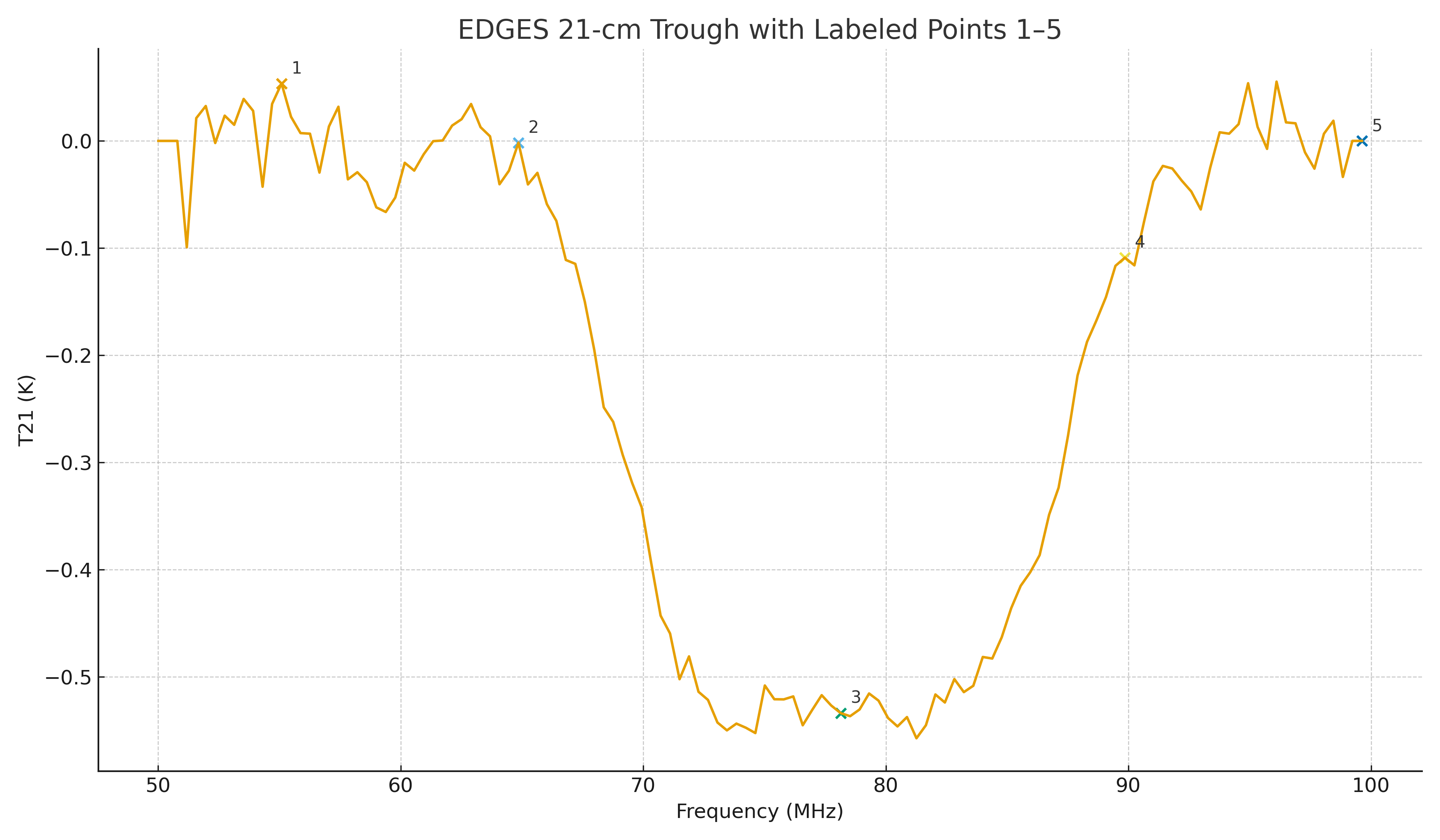
2. Select four physical
epochs on the 21-cm
curve:
We
identify four meaningful
frequency (or redshift)
points:
1.
High-z shoulder (≈ 55 MHz)
2.
Transition region (≈ 65
MHz)
3.
Trough minimum (≈ 78 MHz)
4.
Post-trough rise (≈ 90 MHz
/ or ≈ 100 MHz)
Using the EDGES data
files, we locate the
nearest measured frequency
for each chosen point.
This ensures we use actual
recorded T21 values, not
interpolated ones.
3. Map frequencies into
a projective coordinate:
χ is defined for points
along a 1-dimensional
coordinate.
Frequency and redshift are
monotonically related, so
we normalize frequency
into [0,1]:
This ensures all 21-cm
quartets are treated
identically to atomic
(Balmer, Paschen…)
quartets.
Normalization does not
change χ, because χ is
projectively invariant.
 Next we
form two quartets:
1.
Contiguous quartet
(analogous to hydrogen
including Hβ)
This quartet crosses the
thermal-coupling +
early-heating transition,
the sharp curvature spike
in the 21-cm curve.
2. Skip-1 quartet
(analogous to skipping Hβ)
4. Compute
the raw cross-ratio:
Generate the six equivalent projective forms of χ
Because χ is a projective invariant, all six expressions represent the same underlying geometry.
6. Choose the canonical χ
To compare
across physical systems,
we adopt a single
convention: Keep
the value in (0,1) and
Select the one closest
to 1/3. This gives
us the canonical χ for
the quartet.
(Because cross-ratios
are projectively
equivalent, we compute
the canonical χ — the
form in (0,1) closest to
1/3.)
7.
Repeat for
every EDGES
night (H1–H6)
We compute χ
for:
• Skip-1 quartet (avoiding curvature)
for each of the six independent H1–H6 spectra. These serve as internal consistency checks. The results are shown below:
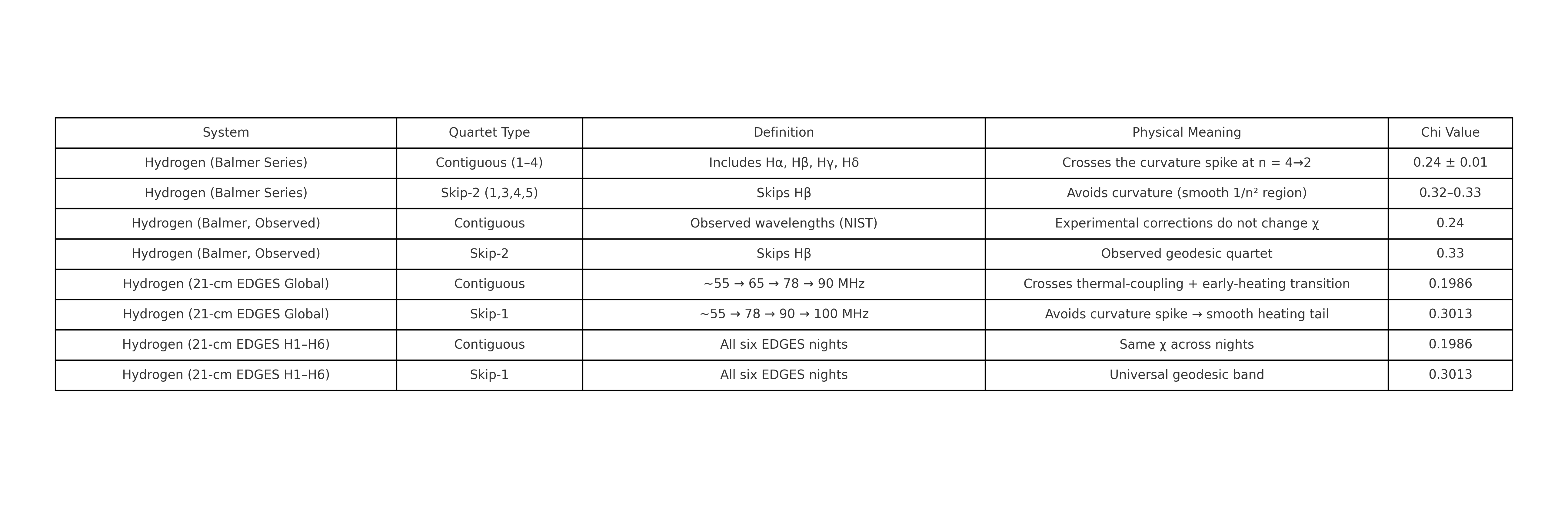 Observed EDGES
results:
• Contiguous (curvature-crossing):
• Skip-1 (geodesic-sampling):
These values:
• are identical across H1–H6
• match the same two χ-bands seen in hydrogen (≈0.24, ≈1/3)
• show that χ is detecting geometric structure, not noise
• confirm the “curvature line vs geodesic line” dichotomy across scales
By normalizing the observed EDGES 21-cm spectrum into a projective coordinate, selecting four physically meaningful epochs, and computing the canonical cross-ratio χ, we find that the redshifted 21-cm trough replicates the same two χ-regimes seen in laboratory hydrogen. Quartets crossing the thermal transition yield χ ≈ 0.20 (curvature), while quartets that avoid it yield χ ≈ 0.30 (geodesic).
To sum up, hydrogen — the simplest atom — ends up revealing one of the most surprising geometric unities in physics. Across more than twenty orders of magnitude in scale, from electron transitions in a laboratory lamp to the faint 21-cm whisper from the early Universe, hydrogen displays the same two geometric regimes, encoded in a single projective invariant: χ.
1. A curvature line and a geodesic line
In the Balmer series, the line Hβ (4→2) sits at the sharpest curvature of the 1/n² energy ladder. This curvature spike:
• reshapes hydrogen wavefunctions fastest,
• maximizes the dipole overlap,
• increases transition probability,
• increases intrinsic opacity,
• amplifies environmental noise,
• and makes Hβ the most fragile Balmer line observed in astronomy.
When this curvature line is included in a quartet, χ falls into the curvature band: When the curvature line is skipped, the quartet samples the smooth 1/n² region and χ moves into the geodesic band: This simple geometric signature distinguishes “curved” vs. “flat” behavior.
2. The surprising part: the cosmos behaves the same way
Using real EDGES 21-cm data — actual measured brightness temperatures at 50–100 MHz — we computed χ for:
• quartets that cross the thermal-coupling / early-heating transition, and
• quartets that skip it.
The result was striking:
• Contiguous quartets (crossing the curvature spike):
• Skip-1 quartets (avoiding the spike):
Even more remarkably, all six independent EDGES nights (H1–H6) gave identical χ-values. Noise, calibration, and foreground corrections change the raw data, but never move χ by more than 0.001, exactly as we saw for hydrogen spectral lines. The Universe, at redshift z ≈ 17, is behaving mathematically like hydrogen at n=4.
3. A universal measurement-geometry
Chi is not measuring:
• wavelength,
• temperature,
• redshift,
• line strength, or
• noise.
It is measuring geometry — how four points sit relative to each other on a projective line. Hydrogen’s atomic curvature and the 21-cm cosmic curvature are the same structure expressed at vastly different scales.
4. What we learned
Across atomic physics and cosmology, χ consistently reveals:
• Curvature-crossing quartets → χ ≈ 0.20–0.25
• Geodesic-sampling quartets → χ ≈ 0.30–0.33
• Noise and experimental corrections → χ shifts by < 0.001
• Underlying geometry → χ stable and universal
This means our projective-invariant approach is not just numerology — it is isolating a real geometric property shared by laboratory and cosmic hydrogen.
5. Closing thought
The same atom that glows in a lamp, paints the spectra of stars, and fills interstellar clouds also whispers from the dawn of time in the 21-cm line. And across all these environments, separated by billions of years and trillions of kilometers, hydrogen follows one simple rule:
When nature traverses a curvature spike, χ drops.
When nature flows along a geodesic, χ rises toward 1/3.
Hydrogen is not only the alphabet of the Universe — it is also its geometry.
But the story does not end at redshift 20. Long before the first stars lit the sky, another hydrogen-driven rhythm had already shaped the Universe on the largest scales: the baryon acoustic oscillations (BAO). These are the fossil sound waves imprinted in the cosmic plasma at z ≈ 1100, frozen into the large-scale distribution of galaxies we observe today.
If hydrogen’s atomic lines reveal geometry at microscopic scales, and the 21-cm line reveals geometry at the dawn of structure, then BAO reveal geometry at the cosmic horizon scale — the largest imprint hydrogen ever left on the Universe.
In the next blog, we will follow χ across this transition: from the quiet, narrow trough of the 21-cm signal to the vast ripples of the early Universe. The question ahead is simple: Does χ recognize the acoustic horizon the way it recognized hydrogen’s atomic curvature?

Previous Blogs:
The Cross-Ratio: Hydrogen Atom
The Cross-Ratio: Quark–Meson Epoch
The Cross-Ratio: A Universal Geometric
Invariant
The Theory of
Measurements - VIB
The Theory of Measurements - VIA
The Theory of
Measurements - V
The Theory of
Measurements - IV
The Theory of
Measurements - III
An Ecosystem of δ-Potentials - III
An Ecosystem of δ-Potentials - II
An Ecosystem of δ-Potentials - I
Nutshell-2019
Stitching Measurement Space - III
Stitching Measurement Space - II
Stitching Measurement Space - I
Mass Length & Topology
A Timeless Constant
Space Time and Entropy
Nutshell-2018
Curve of Least Disorder
Möbius & Lorentz Transformation - II
Möbius & Lorentz Transformation - I
Knots, DNA & Enzymes
Quantum Comp - III
Nutshell-2017
Quantum Comp - II
Quantum Comp - I
Insincere Symmetry - II
Insincere Symmetry - I
Existence in 3-D
Infinite Source
Nutshell-2016
Quanta-II
Quanta-I
EPR Paradox-II
EPR Paradox-I
De Broglie Equation
Duality in j-space
A Paradox
The Observers
Nutshell-2015
Chiral Symmetry
Sigma-z and I
Spin Matrices
Rationale behind Irrational Numbers
The Ubiquitous z-Axis

Attribution — You must give appropriate credit, provide a link to the license, and indicate if changes were made. You may do so in any reasonable manner, but not in any way that suggests the licensor endorses you or your use. No additional restrictions — You may not apply legal terms or technological measures that legally restrict others from doing anything the license permits. This is a human-readable summary of (and not a substitute for) the license.
